Peace on Paper
By: Zain Kashif
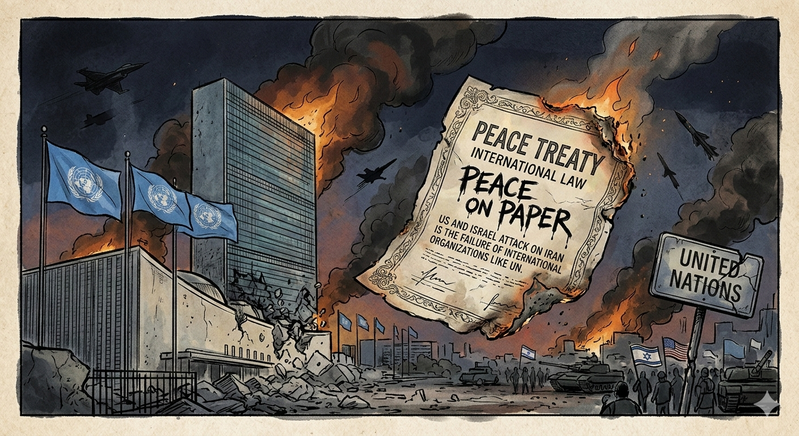

The recent joint military operation by the United States and Israel against Iran described by Washington as a campaign to dismantle perceived threats and by Tehran as a blatant violation of its sovereignty has cast a harsh spotlight on the failures of the international peace architecture that once promised a rules-based global order. In what has rapidly become the most volatile escalation in the Middle East in decades, world powers are not only divided on the legality and prudence of the strikes, but the very institutions entrusted with preserving peace have shown profound impotence in the face of raw power politics. From New York to Brussels, global voices have articulated growing alarm over the conflict’s trajectory. United Nations Secretary-General António Guterres warned that the use of force by powerful states “undermines international peace and security,” stressing the grave risk of a wider conflagration with devastating consequences for civilians and regional stability. Yet the Security Council’s emergency session has yielded little more than appeals for restraint, underscoring how the UN conceived as the guardian of collective security remains unable to prevent or meaningfully check military aggression by influential members or their allies.
European leaders have added to this chorus of concern while revealing the depth of international ambivalence. French President Emmanuel Macron called the situation an “outbreak of war” with “serious consequences for international peace and security,” urging an urgent meeting of the UN Security Council. At the same time, European officials have stopped short of directly challenging the actions of Washington and Tel Aviv, instead urging “maximum restraint” and protection of civilians. This cautious language reflects both growing unease in capitals like Paris and Berlin and the uncomfortable reality that European influence is limited when it comes to confronting its most powerful ally.
On the ground and in capitals across the Global South, reactions have been sharply critical. Pakistan’s representative to the United Nations warned that the US-Israeli attack “risks regional conflagration” and called for an immediate halt to escalation and a return to diplomacy. Malaysia’s Prime Minister Anwar Ibrahim condemned the strikes as “totally irresponsible,” while Russia’s foreign ministry called the assault a “pre-planned and unprovoked act of armed aggression against a sovereign and independent UN member state.” These voices from Asia and beyond reflect a deep scepticism about the narrative of defensive necessity invoked in Washington and Jerusalem.
What unites many of these critiques is not a defence of the Iranian regime’s policies, but a fundamental distrust of how “democracy promotion” is wielded in international politics. For decades, the language of democratic values has been used in Washington to justify military interventions from Iraq in 2003 to Libya in 2011. In both instances, lofty rhetoric about liberation and human rights dissolved into protracted instability, fractured state institutions, and decades of human suffering. Now, in the context of Iran, democratic discourse has again been repurposed as justification for force and implicit pressure for regime change. Israeli Prime Minister Benjamin Netanyahu urged Iranians to “seize the opportunity” and “take their fate into their own hands,” while US authorities framed the offensive as an effort to catalyse internal transformation.
The current crisis also highlights the double standards in international enforcement of law and norms. When weaker states use force outside narrowly defined self-defence parameters, they are quickly condemned. But when powerful nations undertake pre-emptive or preventive strikes, the debate shifts from legality to political necessity. This inconsistency further erodes confidence in international institutions and reinforces the perception that global governance serves the interests of the powerful rather than universal principles.
Ultimately, the Iran conflict is not merely a regional crisis, it is a test of the credibility of the world’s peace mechanisms and the sincerity of democratic ideals proclaimed by powerful states. If democracy is to be more than a pretext for intervention and regime change, the international community must recommit to diplomacy, respect for sovereignty, and genuine multilateral engagement that places human security ahead of geopolitical dominance. Until then, the promise of a rules-based order will remain hollow, and the cycle of war justified in the name of noble rhetoric will only continue.

Comments
No comments yet. Be the first to comment!