A Story of Eastern Flame
By: Zain Kashif

The village of Khanabad sat between two mountains that older men called "the shoulders of God." In winter, snow swallowed the roads whole. In summer, the sun pressed down like a hand on the back of a bowing woman. And in every season, women in Khanabad were expected to live quietly to fold themselves into the shape the world had carved for them. Soraya was born in the season of pomegranates. Her mother, Nasreen, used to say that when Soraya first opened her eyes, she did not cry as most children do. She looked around the room as if she were taking inventory as if she were deciding whether it was enough. It was not enough.
She was seven when she first found her grandfather's book of Persian poetry Rumi, Hafez, Attar. She could not read it fully, but she ran her fingers along the gilded letters as if the ink itself were warmth. Her grandfather, a quiet man with a white beard like smoke, whispered to her: "آتش عشق است کاندر نی فتاد The fire of love has fallen into the reed." She did not understand it then. She would spend her life understanding it.
By twelve, the village had opinions about her. She walked too fast. She asked questions in the mosque courtyard when only boys were expected to speak. She borrowed books from the schoolteacher a shy woman named Maryam Khanum who kept her library behind a curtain as if books were something to be hidden from weather, or from men. Her uncle said a girl who reads too much will find no husband. Her aunt said silence is a woman's gold. Soraya listened carefully, folded those words, and placed them in a room inside herself that she never entered again.
The first real hurdle came at fifteen, when her father was pressured by village elders to withdraw her from school. A girl in secondary school, they said, was an embarrassment to the family's dignity. What would she do with algebra and geography? Marriage required none of these. The night her father told her, Soraya did not shout. She did not weep. She went to the courtyard and sat beneath the fig tree until the stars appeared one by one, as if the sky were slowly remembering something. Then she came inside and said, very quietly: "Baba. I will make tea. And then we will talk." They talked until the call to Fajr prayer rang across the rooftops. She told him not in anger, but in the language of love that her hunger for learning was not a betrayal of their family. It was, in fact, the highest form of honor she could offer their name. Her father sat in silence for a long time. Then he said: "Study. But be careful of how you carry yourself." She bowed her head. She had learned that dignity was a negotiation, not a gift.
At nineteen, she sat the university entrance examination in the provincial city, traveling four hours by bus with her mother's old dupatta wrapped around her shoulders like armor. She carried a thermos of chai, two boiled eggs, and a worn copy of Faiz Ahmed Faiz, which she read while other passengers slept. She passed first in the district in literature and language. When the result came, her mother pressed her forehead to Soraya's and wept. Not sad tears. The other kind the kind that have been held too long and finally find permission to fall.
University was another country entirely. The city girls wore perfume she had no name for. The professors spoke in a register she had to climb toward. Some classmates looked at the dust on her shoes and made their quiet calculations. Soraya learned to look at that same dust and feel it as a credential evidence that she had walked far to be here. She slept four hours a night. She cleaned a professor's office in exchange for access to his private library. She ate dal and bread and considered it a luxury because it meant she was here, in this room, in this life she had built from permission borrowed, argued, and prayed for. She wrote her thesis on the feminine voice in classical Persian poetry how Rabi'a al-Adawiyya, Mahsati Ganjavi, and Forough Farrokhzad had hidden entire seas inside lines that men walked past as if they were merely decorative. Her advisor, a small sharp-eyed woman who had survived three different regimes, read the thesis and said nothing for a long time. Then: "You understand something most of my students do not. You know that words can be a door."
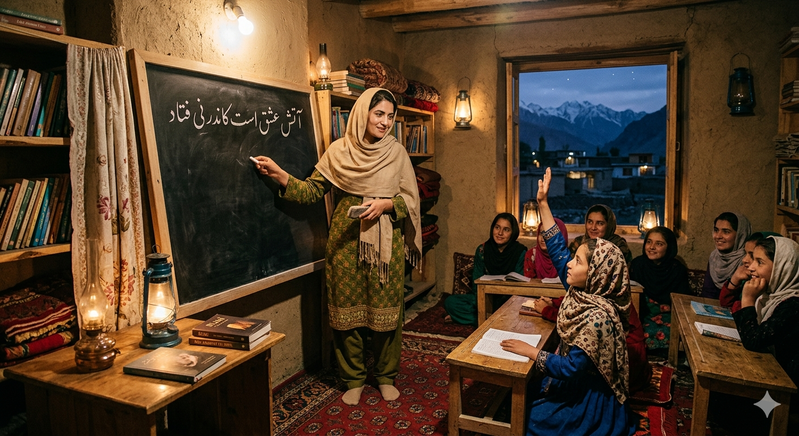
Soraya graduated, when the apricot trees in the university garden had just burst into bloom. Her father was there, wearing his best shalwar kameez, looking simultaneously out of place and enormously, quietly proud. Her mother had never left the village, but Soraya carried her in the fold of her dupatta and in the way she stood when they called her name straight, not rigid, rooted. She returned to Khanabad as a teacher. The same village. The same mountains holding the sky on either side. But she was not the same girl who had once sat beneath the fig tree counting stars. She opened a class for women in the back room of Maryam Khanum's old house the one with books behind the curtain and she taught language, poetry, and the quiet but radical truth that silence was sometimes wisdom and sometimes a wound, and that every girl was allowed to know the difference.
On the first evening of class, a girl of eleven sat in the back row and said nothing, but watched everything with eyes that were already taking inventory. Soraya looked at her and felt the long thread of it, Rumi to her grandfather, her grandfather to her, her to this child sitting before her now, and beyond. She picked up the chalk and wrote on the board: آتش عشق است کاندر نی فتاد. Then she turned and said, "The fire of love has fallen into the reed. Does anyone know what that means?" The girl in the back row raised her hand. And that is where the story opens, not where it ends.
Comments
No comments yet. Be the first to comment!